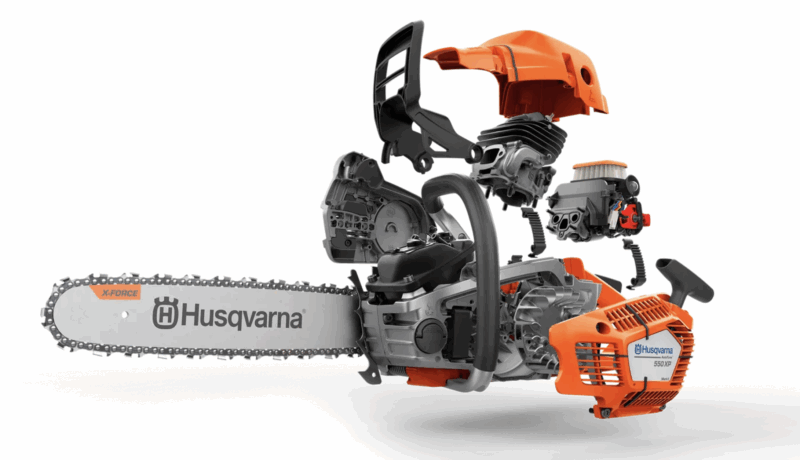
Husqvarna Group is reshaping how it develops next-generation batteries by pairing a lean internal team with a broad, global network of suppliers, startups and research partners. The strategy is designed to secure high‑performance, cost‑competitive cells for everything from professional chainsaws to robotic lawn mowers, while reducing reliance on Asian manufacturing over time.
At the center of the effort is a small Husqvarna Group cell technology team that scans the global market for solutions across chemistries, formats and geographies. “We have very spread needs, you can say from low power to high power and few cycles to high cycles”, explained Anders Gidoff, Sr Systems Engineer from Husqvarna Group’s Battery Competence Center.
This combination of high power, long life and low weight means Husqvarna Group is constantly trading off energy density, power density, cost and durability in evaluating current and new technologies, to keep offering the best quality for the markets.
Startups as a strategic extension
Husqvarna Group maintains active technical discussions with a broad set of industrial cell suppliers, to stay up to date on the market development. They also actively test new cells from suppliers and scout new cell providers from emerging companies with the help of Combient Foundry. This is complemented by collaborations with universities and academia, giving the group visibility from fundamental materials research all the way to piloting‑ready cells. Husqvarna Group is also part of a battery alliance with Bosch, including several brands like Gardena, Flymo and more, enabling consumers to use the same battery for multiple devices.
Startups are mapped across chemistries, from advanced lithium‑ion variants and solid‑state concepts to a smaller number of sodium‑ion plays, and across roles: materials developers, technology developers, cell manufacturers and systems integrators.
The company is open to earlier‑stage innovation, but only up to a point. For Husqvarna Group’s product roadmaps, founders need to be beyond the slide‑deck phase. “It cannot be too immature,” Gidoff stressed. Startups “must have something to be sent to us for testing… piloting is the right word,” because the technologies under consideration are expected to come into play longer than five years from now.
Combient Foundry’s process gives Husqvarna Group a repeatable funnel: global scouting, internal evaluation and staged engagement. Subsequent steps include online meetings and, at later stages, physical meetings with selected startups.
Case in Point: Successful Testing with EnPower
A prime example of this model in practice is the collaboration with EnPower, a US based company founded in 2014 that manufactures high-energy-density lithium-ion cells featuring patented multi-layered anode technology. After EnPower submitted their solution to Combient Foundry in early 2023 and caught the attention of both Husqvarna Group and SKF in the process.
With over 20 patent families and a 92,000 sq. ft. production facility in Indianapolis, EnPower produces high-energy-density cells with electrode architectures that deliver 3x faster charging, 70% more power, and a longer service life than most standard lithium-ion batteries.
In a dedicated pilot project, Husqvarna Group evaluated EnPower’s pouch-cell equipped with their patented multilayer electrode technology. After testing two generations of cells, the technical results were successful, performing on par with the high-end cylindrical cells currently in use. Anders Gidoff, Sr. Systems Engineer at Husqvarna Group, praised the startup’s engagement: “They performed extensive testing and deep-dive investigations for us.” The ability to tailor pouch cell dimensions to optimize pack geometry provided an additional strategic advantage.
“Working with Husqvarna Group has been fantastic; the team is very responsive and flexible, and we have had regular check-ins to ensure the testing is working successfully.” – Adrian Yao, Founder & CEO at EnPower
The pilot concluded in 2025, leaving behind a high-quality professional connection. While EnPower’s pouch battery technology offered a strong balance between runtime and power, Husqvarna Group’s specific needs are currently better met by traditional, high-performing cylindrical cells. The decision to conclude the project was mutual; both parties agreed that while the pouch cells were effective, traditional cylindrical cells were a better fit for the intended products and markets.
“Through the collaboration, Husqvarna Group gained insights from pouch-cell testing and could save time by using EnPower expertise.” – Anders Gidoff, Sr. Systems Engineer at Husqvarna Group
The 2026 pipeline includes global collaboration with multiple startups
Currently, the Battery Competence Center is testing cells from three startups identified through Combient Foundry. The evaluation focuses on two main dimensions:
- Life cycle testing: Measuring charge-discharge durability under defined conditions.
- Load and high-power testing: Pushing cells to their limits to ensure suitability for demanding power tools.
Depending on the application, some tests take several months, while others take a full year, occasionally accelerated by high-temperature regimes. In parallel, partner companies run identical test profiles, allowing for a direct comparison between Husqvarna Group’s lab data and the suppliers’ internal benchmarks.
The search for new partners launched in early 2026 as part of the Combient Foundry cycle 1/2026, with a primary focus on high-energy-density batteries. Because new players enter the market constantly, continuous landscape monitoring is essential. In the startup and scaleup ecosystem, a single year can represent a massive leap in technological maturity, particularly when venture capital funding allows these companies to hire aggressively and accelerate R&D.
“Collaboration with Combient Foundry has provided excellent contacts and a deep understanding of what is ‘cooking’ in the battery business, while helping us narrow down which companies are most relevant for deep-dive collaboration.” – Anders Gidoff, Sr. Systems Engineer, Husqvarna Group’s Battery Competence Center
Husqvarna Group’s model illustrates how an established manufacturer can stay at the innovation frontier without building everything in-house. By combining a focused, highly skilled internal team with targeted startup pilots, the company systematically explores new chemistries while keeping its specific product requirements at the center.